

An air start unit (ASU) is a towable diesel compressor that feeds air to a jet engine’s starter. Sizing one comes down to a single number: pounds per minute (ppm) of airflow. This guide explains how to match ppm to your aircraft, using the air start units currently listed at Victory GSE.
Quick Answer: Size an air start unit by the airflow your engines need, measured in pounds per minute. Units around 120 to 180 ppm cover most narrow-body and regional jets. Units around 250 ppm cover most wide-bodies except the largest engines. For the Boeing 777 or Airbus A380, Textron lists only its 270 and 330 ppm models.
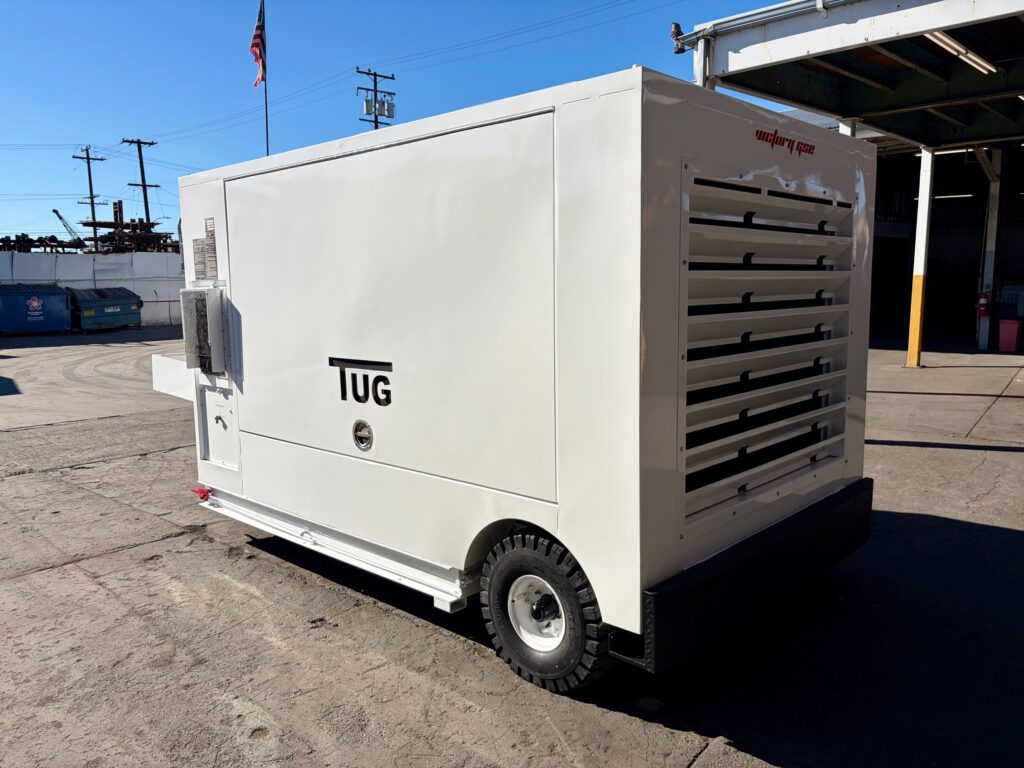
What Does PPM Mean on an Air Start Unit?
PPM is the mass of air the unit delivers each minute. It decides which engines an ASU can start. A higher ppm unit spins a larger engine’s compressor faster and holds it there longer. Textron GSE rates its current TUG TMD line at 180, 270 and 330 lb per minute at 68°F (Textron GSE TUG TMD specs).
Note the temperature in that rating. Air is less dense on a hot ramp, so a unit’s real delivered mass flow drops on a summer afternoon. That is one reason operators in hot climates often size with some headroom above the engine’s minimum.
PPM vs. PSI: Why Both Numbers Matter
Pressure gets air to the starter, but flow is what keeps the engine accelerating. The FAA’s powerplant handbook says one air source of around 30 to 50 psi starts the engines, with a normal minimum of about 30 psi (FAA AMT Powerplant Handbook, Ch. 5).
A small unit can reach starter pressure and still fall short on flow. When that happens, the engine accelerates slowly. The FAA handbook warns that releasing the starter too early can cause a hot or hung false start. Matching ppm to the engine is how you avoid a unit that is close but not enough.
The same FAA chapter lists three air sources: a ground air cart, the APU, or a cross-bleed start. An ASU is the ground cart in that list.
Air Start Units Listed at Victory GSE
Victory GSE currently lists seven diesel air start units, ranging from 120 to 270 ppm. The table below uses the ppm rating and drive details shown on each listing. You can browse all of them on the air start units category page.
| Model | Rated output | Power and setup (per listing) | General size class |
|---|---|---|---|
| Stewart & Stevenson TMSS-120 | 120 ppm | Detroit Diesel, towable | Narrow-body |
| Stewart & Stevenson TMAC-170 | 170 ppm | Diesel, towable | Narrow-body and regional |
| TUG TMD-180 | 180 ppm | Detroit Diesel, trailer-mounted | Narrow-body and regional |
| TUG TMD-250 | 250 ppm | Diesel, dual-pressure regulators | Most wide-bodies |
| Stewart & Stevenson TMAC-250 | 250 ppm | Diesel, towable | Most wide-bodies |
| Davco AS250 | 250 ppm | Diesel, trailer-mounted | Most wide-bodies |
| TLD ACE-600-2270 | 270 ppm | Detroit Diesel, trailer-mounted | Highest output listed |

How to Match PPM to Your Aircraft
The fastest way to size an ASU is to check the manufacturer’s compatibility list, then confirm against your aircraft maintenance manual. Textron GSE publishes a list for each TMD output class (Textron GSE TMD aircraft compatibility). The table below summarizes it for the three classes closest to the units Victory lists.
| Textron output class | Examples on Textron’s compatibility list | Not on the list |
|---|---|---|
| TMD-180 (180 ppm) | A318 to A321, B737, B757, B717, CRJ100 to CRJ1000, ERJ135 to ERJ195, C-130J | B767, B747, B777, A330, A340, A350, A380 |
| TMD-250 (250 ppm) | Everything above plus B767, B747, A330, A340, A350, C-5 | B777, A380 |
| TMD-270 (270 ppm) | Everything above plus B777 and A380 | None of the types Textron lists |
Victory’s TMD-250 listing makes the same point. It handles wide-body engines needing 250 ppm, except the B-777. Textron also notes that compatibility can vary by model of TMD, so treat these lists as a starting point.
Use this simple process to size a unit:
- List every aircraft type you start on the ramp today, and any you expect to add.
- Find the largest engine in that list and its start air requirement in the AMM.
- Pick a ppm class that covers it, with headroom if your ramp runs hot.
- Check hose length, connector type and tow setup against your gates.

Not sure which ppm class fits your fleet?
Buy, rent or lease an air start unit from Victory GSE in Los Angeles. Tell us the aircraft you start and your timeline, and we will point you to the right unit.
Narrow-Body and Regional Jets: 120 to 180 PPM
For a fleet of A320-family, 737, CRJ or E-Jet aircraft, a unit in the 120 to 180 ppm range is the usual fit. Victory’s TMSS-120 listing describes it as sized for narrow-body aircraft. The TMAC-170 and TMD-180 add more flow for hot days or larger narrow-body engines.
The 757 shows up on Textron’s 180 ppm list, so a 180 ppm unit covers a wider mix than a 120. If your ramp sees several narrow-body types, the higher end of this range gives you more room.
Wide-Body Aircraft: 250 to 270 PPM
Wide-body operations need a unit around 250 ppm or more. Victory lists three 250 ppm units: the TUG TMD-250, the Stewart & Stevenson TMAC-250 and the Davco AS250. Textron’s 250 ppm list covers the 767, 747, A330, A340 and A350.
The TUG TMD-250 listing describes an “On Demand” throttle system with dual-pressure regulators. The operator selects air start or air packs mode, and the controls adjust pressure and throttle. That makes it useful on ramps that also need pre-conditioning air from the same unit.
The TLD ACE-600-2270 is the highest-output unit Victory lists, at 270 ppm. For the 777 or A380, confirm the engine’s start air requirement in the AMM before choosing any unit.

Air Start Units Work Alongside Ground Power
An ASU supplies air for the starter, while a ground power unit supplies electrical power to the aircraft. Many ramps run both at the gate during an engine start. If you are also choosing ground power, our guide to 400 Hz vs. 28 VDC ground power units covers how to match a GPU to your aircraft.
For how air starts fit with tractors, stairs and loaders, see what ground support equipment is and how each type is used.
Buying, Renting or Leasing an Air Start Unit
Victory GSE offers its air start units to buy, rent or lease. Buying suits operators who start aircraft every day at the same station. Renting or leasing can fit a new route, a seasonal schedule or a short-term contract.
Either way, the sizing steps above still apply. Tell us your aircraft types and schedule, and we can talk through which listed unit matches the work.
Air Start Unit Sizing FAQ
What does ppm mean on an air start unit?
PPM stands for pounds per minute, the mass of air the unit delivers to the engine starter each minute. It is the main rating used to match an ASU to an engine. Manufacturers such as Textron GSE state it at a set air temperature, usually 68°F.
What size air start unit do I need for a Boeing 737 or A320?
Textron GSE lists the 737 and the A318 through A321 as compatible with its 180 ppm TMD-180. Units in the 120 to 180 ppm range are common for these aircraft. Always confirm the start air requirement in your aircraft maintenance manual.
Is a higher ppm air start unit always better?
A higher ppm unit covers more aircraft types, but it is also larger and heavier to tow. Textron’s current TMD models weigh 12,600 to 13,300 lb. If you only start narrow-body jets, a smaller unit may be the better fit for your ramp.
Can one air start unit start both engines?
Yes, one engine at a time. The FAA handbook notes that only one air source is used at a time to start the engines. Once the first engine runs, crews can use a cross-bleed start for the second engine where the aircraft allows it.
Can I rent or lease an air start unit instead of buying?
Yes. Victory GSE offers its listed air start units to buy, rent or lease. Contact us with your aircraft types and timeline to discuss the options.
Buy, rent or lease an air start unit
Victory GSE lists air start units from 120 to 270 ppm in Los Angeles. Send us your aircraft types and we will help you pick the right one.
