

Last reviewed: October 2026
Ground support equipment (GSE) is the set of vehicles and carts that service a parked aircraft. It works at the gate, on the ramp and in the hangar. It tows, powers, cools, starts, loads and boards aircraft between flights. This guide covers the main types of GSE, what each one does and how buyers size it.
Quick answer: Ground support equipment is the airport gear that keeps a parked aircraft running without its engines. The main types are baggage and pushback tractors, ground power, air start and air conditioning units, and belt loaders. Boarding stairs, maintenance stands and lavatory and water trucks complete the list. Each type is sized to the aircraft it serves.
What Does Ground Support Equipment Do?
Ground support equipment handles every job an aircraft cannot do for itself on the ground. An aircraft cannot back away from a gate on its own or lift bags into its hold. It also needs outside power, air and access while its engines are off. GSE fills those gaps so the aircraft can turn around and leave on time.
The scale of that work is large. The FAA reports an average of 44,360 flights handled per day in fiscal year 2024. More than 3 million passengers fly daily. Nearly every one of those flights relies on some mix of GSE at both ends of the trip.
Here is how the equipment lines up during a typical narrow-body turn:
- Arrival: the aircraft parks, a ground power unit plugs in and an air conditioning unit connects its duct hose.
- Unloading: stairs or a jet bridge reach the doors. A belt loader moves bags from the hold to carts.
- Servicing: lavatory and potable water trucks empty waste tanks and refill drinking water.
- Loading: baggage tractors pull loaded carts back to the belt loader for the outbound flight.
- Departure: an air start unit starts the engines if the APU is down. A pushback tractor then moves the aircraft off the gate.
The FAA’s Advisory Circular 00-34B, issued in July 2024, gives guidance on aircraft ground handling, servicing and marshalling. It is a useful reference for anyone setting up a ramp operation.
The 9 Main Types of Ground Support Equipment
GSE falls into nine practical groups based on the job each unit does. The table below lists each type, its role and the number buyers use to size it. The examples are units currently listed in the Victory GSE ground support equipment inventory.
| GSE type | What it does | How it is sized | Examples listed at Victory GSE |
|---|---|---|---|
| Baggage tractor | Tows baggage carts, cargo dollies and service carts | Drawbar pull (lb) | TUG MA-50, Harlan HTAG-40, Tiger TC-40 |
| Pushback tractor | Pushes aircraft back from the gate and tows them | Drawbar pull and aircraft weight class | TUG GT-35, JBT B250, NMC Wollard MB-4 |
| Ground power unit (GPU) | Supplies electrical power to a parked aircraft | kVA rating, 400 Hz AC or 28 VDC output | Hobart Jet-Ex 4D, TLD GPU-4000, Tronair 112820C |
| Air start unit (ASU) | Delivers high-volume air to start main engines | Airflow in pounds per minute (ppm) | TUG TMD-250, Stewart & Stevenson TMAC-170, Davco AS250 |
| Air conditioning unit (ACU) | Cools or heats the cabin through a duct hose | Tons of cooling | TLD ACE 802, Trilectron DAC200, TUG AC-25D |
| Belt loader | Moves bags and loose cargo between ramp and hold | Sill height reach and conveyor length | TUG 660, Tiger BL-2000, Wasp A206091D |
| Boarding stairs | Gives passengers and crew access to aircraft doors | Door sill height range | Stinar SPS-3518, Nordco 3016, Lift A Loft AS228CC |
| Maintenance stand | Raises technicians to gear, wings, engines and tail | Working platform height | B-1, B-2, B-4, B-5 stands |
| Service and other GSE | Lavatory and water service, passenger lifts, carts and towbars | Tank capacity or lift height | Phoenix lavatory/water truck, Stinar SPW-350PL, Lift-A-Loft APX16DPL |
Towing Equipment: Baggage Tractors and Pushback Tractors
Towing GSE moves loads and aircraft across the ramp without using aircraft engines. It splits into two groups that are easy to confuse. Baggage tractors pull carts and light equipment, while pushback tractors move the aircraft itself.
A baggage tractor is rated by drawbar pull, the pulling force it can apply at the hitch. Textron GSE’s TUG MA line runs from 3,000 lb on the MA-30 to 6,000 lb on the MA-60. The TUG MA-50 sits at 5,000 lb, near the top of the line. Specifications are subject to change.

A pushback tractor is a low, heavy tow vehicle that connects to the nose gear with a towbar. Its weight and drawbar pull decide which aircraft it can move. Small units handle business jets, and larger units push narrow-body and wide-body aircraft. See the pushback tractors Victory GSE lists for the current range of models.
Ground Power, Air Start and Air Conditioning Units
Ground power, air start and air conditioning units replace the aircraft’s own APU while it sits on the ground. Running the APU burns fuel and adds noise at the gate. Many airports limit APU use, which makes these three carts a standard part of the ramp.
A ground power unit supplies electricity for avionics, lighting and cabin systems. Aircraft power needs range from 28 volts DC to 115 volts 400 Hz AC, according to Tronair. Most airliners use 400 Hz AC, while many business jets and turboprops use 28 VDC. Matching output type is the first step in picking a GPU.

An air start unit is a diesel-powered compressor that sends high-volume air into the engine to start it. Operators size ASUs by airflow in pounds per minute. The air start units on Victory GSE’s site include TUG, TLD, Davco and Stewart & Stevenson models.
An air conditioning unit pushes cooled or heated air into the cabin through a duct hose. Capacity is rated in tons of cooling. Larger aircraft and hot climates need more tons to keep the cabin and avionics at a safe temperature.
Loading and Boarding Equipment: Belt Loaders and Stairs
Loading and boarding GSE works right against the fuselage, so fit and control matter more here than raw power. A belt loader parks at the cargo door and runs a powered conveyor between the ramp and the hold. Buyers check sill height reach first, then conveyor length and power type. Victory GSE offers both electric and diesel options in this group.
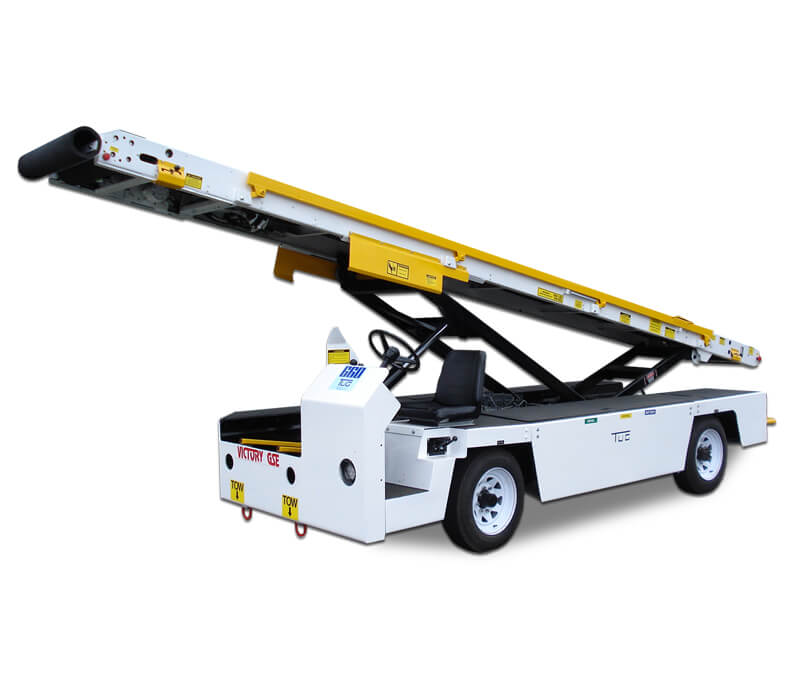
This group also carries the most risk to the aircraft. Per IATA’s ground damage report, belt loaders, cargo loaders, passenger stairs and boarding bridges cause 40% of incidents. IATA also warns the annual cost of ground damage could double to nearly $10 billion by 2035. Picking a unit that matches your door heights cuts down on awkward approaches.
Boarding stairs give passengers and crew access to doors when no jet bridge is in use. They come as self-propelled stair trucks or towable hydraulic stairs. Each model covers a set range of door sill heights, so confirm your fleet falls inside it.

Need ground support equipment for your ramp?
Buy, rent or lease GSE from Victory GSE in Los Angeles. Tell us the aircraft you handle, your workload and your timeline.
Maintenance Stands and Other Service Equipment
Maintenance stands are mobile work platforms that raise technicians to the landing gear, wings, engines and tail. The B-series stands (B-1, B-2, B-4 and B-5) are the common military-spec types. Each one covers a different working height, from low gear work up to tall tail access. Browse the B-series maintenance stands to compare the listed types.
The rest of the GSE fleet covers jobs outside the main categories. Lavatory service trucks empty and flush waste tanks, and potable water trucks refill drinking water. Lift-A-Loft passenger lifts raise passengers who cannot use stairs. Baggage carts, cargo dollies, towbars and engine wash rigs round out the group.
Powered vs. Towable GSE
Every GSE unit is either self-powered or towed by another vehicle. This split affects how many tractors you need, and buyers often overlook it. A towable GPU or ACU needs a baggage tractor to move it between gates.
| Self-powered GSE | Towable GSE |
|---|---|
| Baggage and pushback tractors | Many portable GPUs and ACUs |
| Belt loaders | Towable hydraulic boarding stairs |
| Self-propelled stair trucks | Lavatory carts such as the Stinar SLC-74 |
| Lavatory and water trucks on truck chassis | Maintenance stands, baggage carts and dollies |
If most of your fleet is towable, plan tractor capacity first. A single baggage tractor such as the TUG MA-50 can move carts, GPUs and service carts in turn.
How to Match GSE to Your Aircraft and Operation
The right GSE depends on the aircraft you handle and how often you handle them. Start with your largest and most frequent aircraft types. Then work through these checks for each unit:
- Power output: 400 Hz AC or 28 VDC for GPUs, and enough kVA for the aircraft’s load.
- Reach: sill heights for belt loaders and stairs, and platform height for stands.
- Pulling force: drawbar pull for tractors, matched to your heaviest cart train or aircraft.
- Airflow and cooling: ppm for air start units and tons for ACUs.
- Fuel and power type: diesel, gasoline or electric, based on your site and local rules.
Write these numbers down for each aircraft type before you contact a supplier. It turns a broad request into a short list of models that fit.
Buying, Renting or Leasing Ground Support Equipment
Victory GSE sells, rents and leases ground support equipment, so you can pick the option that fits your operation. Buying suits units you will use every day for years. Renting or leasing suits seasonal peaks, new routes or a trial of a model before you commit. Tell us the aircraft you handle and your timeline, and we will point you to listed units that match.
Ground Support Equipment FAQ
What does GSE stand for in aviation?
GSE stands for ground support equipment. It covers the vehicles and carts that service aircraft on the ground between flights. Common examples are baggage tractors, ground power units, belt loaders and boarding stairs.
Is a ground power unit the same as an APU?
No. An APU is a small engine built into the aircraft that makes power and air. A ground power unit is a separate cart on the ramp. It supplies electrical power so the APU can stay off.
What is the difference between a baggage tractor and a pushback tractor?
A baggage tractor tows carts, dollies and light equipment across the ramp. A pushback tractor is heavier and moves the aircraft itself, usually through a towbar on the nose gear. They are sized by different weight classes.
Can I rent or lease ground support equipment instead of buying?
Yes. Victory GSE rents and leases ground support equipment as well as selling it. Contact the team with the equipment type and your timeline to discuss the options.
Are maintenance stands considered ground support equipment?
Yes. Maintenance stands are part of GSE because they support work on a parked aircraft. B-series stands give technicians safe access to gear, wings, engines and tail sections in hangars and on the ramp.
What GSE does a small FBO need first?
A common starting set is a baggage tractor, a ground power unit and boarding stairs. A tractor such as the TUG MA-50 can also tow the GPU and other carts. Add more units as traffic and aircraft size grow.
Buy, rent or lease ground support equipment
Victory GSE lists tractors, GPUs, air start units, ACUs, belt loaders, stairs and stands in Los Angeles. Send us your aircraft types and timeline for a quote.
